Who Samik Bhattacharya is, where he comes from, and how a schoolboy at a Howrah
shakha in 1971 arrived at the presidency of a state party unit fifty-four years later.
Subject Samik BhattacharyaBorn 5 November 1963State West Bengal
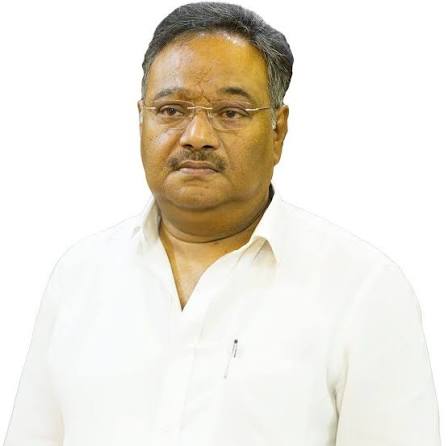
Portrait
Formal photograph, presented uncropped at its original proportions.
01 — Origins
Born in Assam, formed in Howrah
Samik Bhattacharya was born on 5 November 1963 in the village of
Maligaon in Assam. His formation, however, belongs to West Bengal, and
specifically to Howrah — the industrial district on the western bank of the
Hooghly, facing Kolkata across the river.
It was in Howrah, at Mandirtala, that he began attending Rashtriya Swayamsevak
Sangh shakhas in 1971, while still at school. He was eight years
old. That early and uninterrupted association is the single most consistent fact
of his public life, and the one most often cited when journalists explain his
standing inside the party.
02 — Education
Surendranath College, 1988
He took a Bachelor of Arts degree from Surendranath College in
Kolkata in 1988. During his student years he was associated with the Akhil
Bharatiya Vidyarthi Parishad, the student organisation aligned with the Sangh.
Surendranath College sits in north Kolkata, in a part of the city with a dense
institutional history; the student politics of Bengal in the 1980s was dominated
by the Left, which held state power continuously from 1977. A student activist of
the ABVP in that period was, by definition, working from a minority position.
Why 1971 matters
Indian political careers are frequently read through the length and continuity of
organisational association rather than through office alone. Bhattacharya's
record — RSS from 1971, BJP from the early 1980s, and no recorded change of
party since — places him in the category of the career organisation worker
rather than the lateral entrant, a distinction that carried weight when the
state presidency was decided in 2025.
03 — Entry into public life
The youth wing, and eleven years in one post
He joined the Bharatiya Janata Party in the early 1980s, within a
few years of the party's founding in 1980. His first offices came in the
Bharatiya Janata Yuva Morcha, the party's youth wing: general
secretary of the South Howrah mandal in the early 1990s, then general secretary
for the Howrah district, and then state general secretary of the youth wing
— a post he held for eleven years.
An eleven-year tenure in a single organisational post is unusual, and it is
explicable mainly by context: through the 1990s and 2000s the BJP was a marginal
electoral force in West Bengal, and its state structures changed hands slowly.
The work was structural rather than electoral.
04 — Political development
Three terms as state general secretary
Bhattacharya went on to serve three non-consecutive terms as state
general secretary of the BJP in West Bengal — the office that carries
day-to-day charge of the state organisation — and he is a member of the
party's National Council. Press profiles published at the time of
his 2025 elevation noted that he had worked under nine successive state
presidents without holding the post himself.
In 2020 he became chief spokesperson of the West
Bengal unit, a role he held until 2024. It is the office in which he became most
widely recognised outside the party: the person who states the state unit's
position, in Bengali and in English, on television and at the press conference.
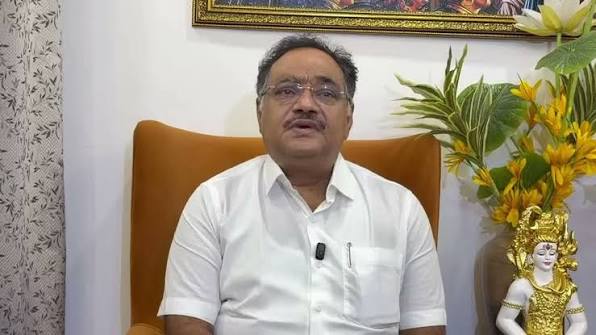
Plate
Recording a statement. Between 2020 and 2024 he was the West Bengal unit's chief
spokesperson, and the format — direct address, seated, to camera —
became a familiar one.
05 — Important transitions
Legislator, parliamentarian, state president
Three transitions define the later part of the record. The first was electoral:
in September 2014 he won the Basirhat Dakshin by-election and
entered the West Bengal Legislative Assembly, serving until May 2016. He was only
the second BJP member ever to sit in that House.
The second was parliamentary: in April 2024 he was elected
unopposed to the Rajya Sabha from West Bengal, taking his seat on
3 April. He was appointed to the Standing Committee on Home Affairs in September
that year, and to the Institute Body of AIIMS Kalyani.
The third was organisational: on 3 July 2025 he was elected
unopposed as the eleventh president of the BJP's West Bengal unit, taking charge
at Science City in Kolkata in the presence of his predecessor Sukanta Majumdar
and the Leader of the Opposition, Suvendu Adhikari.
06 — Historical context
A state that changed around him
West Bengal's politics over Bhattacharya's career divides cleanly into three
phases. The Left Front governed from 1977 to 2011 — thirty-four
consecutive years. The Trinamool Congress governed from 2011. The BJP, which had
no Assembly representation in the state between 1999 and 2014, rose to 77 seats
in 2021 and to 208 in the 2026 election, forming a government in the state for
the first time.
Bhattacharya's organisational work spans all three phases. He was state general
secretary of a party with no legislators; he became one of its first legislators;
and he held the state presidency through the election at which it took office.